
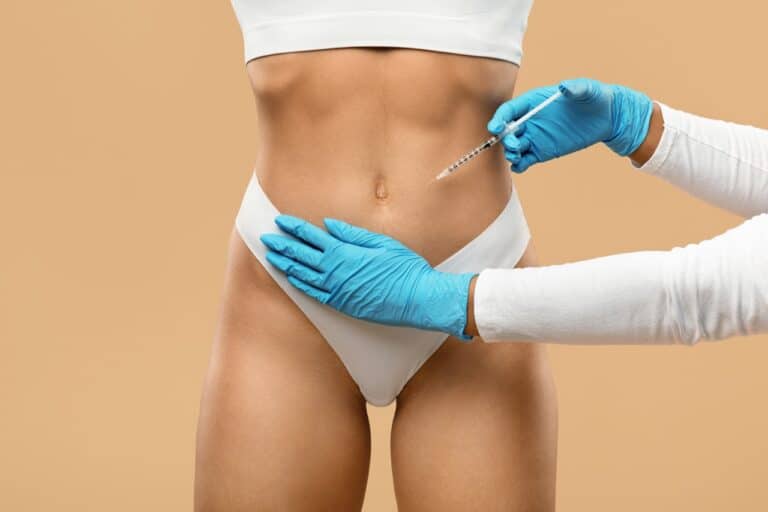
Lipolysis is a highly innovative and effective medical aesthetic procedure that aims to reduce stubborn, localised fat deposits that resist diet and exercise, without surgery. Some areas of the body have fat stores that simply will not shift, however much we exercise or watch what we eat. Fat that gathers in areas such as the double chin, abdomen, hips, inner knees or arms can disrupt the overall aesthetic harmony of the body and affect a person’s happiness and self-confidence. Lipolysis treatment targets these resistant fat cells and triggers a process that allows them to be eliminated from the body naturally. It is not a weight-loss method but the art of localised slimming and body contouring. Its main aim is to give the body’s contours a smoother, more proportionate and more aesthetic appearance. The success of the procedure depends on the right technique, the right patient and treatment by an experienced doctor. Every body is unique and every person has different expectations, so lipolysis requires a personalised treatment plan. In Istanbul, one of the world’s leading cities for aesthetics and health, demand for such advanced treatments is high. In Beşiktaş, Dr. Selin Zehra Uçar combines a scientific basis with an artistic vision in lipolysis treatment, offering her patients safe, effective and satisfying results. In this article we look in detail at what lipolysis is, how it works, who it suits and how it can give your body a more elegant shape.
A Non-Surgical Solution for Stubborn Fat: The Science of Lipolysis
The word lipolysis literally means “the breakdown of fat” (lipo: fat, lysis: breakdown). In medicine, the term describes the process by which fat cells (adipocytes) are broken down chemically or physically, converting the triglycerides they contain into free fatty acids and glycerol. This process also occurs naturally in our bodies. When we exercise or need energy, our hormones signal the fat cells to start this breakdown, and the resulting fatty acids are used for energy. Lipolysis treatments in medical aesthetics are based on the principle of intervening externally to speed up and concentrate this natural process in a specific area. Their core philosophy is to provide localised slimming in a more comfortable, minimally invasive way, without the risks and long recovery of surgical methods such as liposuction. Although there are different technologies such as laser lipolysis and cryolipolysis, one of the most common and effective methods in medical aesthetic clinics is injection lipolysis. In this method, a special mixture containing substances such as phosphatidylcholine (PPC), derived from soybeans, and deoxycholate, a bile acid, is injected directly into the targeted fat tissue through very fine needles. These substances trigger the breakdown of fat cells by increasing the permeability of their membranes and disrupting their structure. When the membrane breaks down, the fat cell releases its contents into the space between cells. The body’s natural clean-up mechanisms then come into play. Macrophages, the body’s “scavenger cells”, arrive in the area, engulf the released fat particles and remove them from the area via the lymphatic system. The fat is then transported to the liver, where it is metabolised and eliminated naturally. This process is not sudden or traumatic; it progresses slowly and in a biologically compatible way. It usually takes several weeks, and the body needs time before the final results are visible. Another important advantage of lipolysis is that it can not only break down fat cells but also improve the quality of the skin in the treated area. The body starts a healing process where the fat cells have broken down, which can trigger collagen production and help the skin look firmer and tighter. At her clinic in Beşiktaş, Istanbul, Dr. Selin Zehra Uçar plans every lipolysis treatment after carefully assessing the patient’s anatomy, the thickness of the fat tissue and the condition of the skin. This careful approach ensures that the treatment is not only effective but also very safe, producing aesthetic results that suit the body’s natural contours.
Lipolysis
Lipolysis, especially in the form known as injection lipolysis, has been a revolution in body shaping. The procedure is an ideal solution for people who are generally not overweight but have stubborn fat deposits in certain areas that do not respond to diet and exercise. It is not an obesity treatment; rather, like a sculptor chipping away the excess from a block of marble to reveal the form beneath, it is used to refine and define the body’s contours. Lipolysis can be used in a wide variety of areas, making it a versatile body-contouring tool.
Treatment Areas:
Double chin (submental area): Fat under the chin is one of the most common problems affecting facial expression and profile. Lipolysis injections to dissolve a double chin make the jawline sharper and more defined and the neck look slimmer and more elegant. Offering a dramatic improvement to the profile without surgery makes lipolysis in this area extremely popular.
Abdomen and waist (love handles): Fat that accumulates on the lower abdomen and the sides of the waist forms stubborn deposits that spoil the fit of clothes and affect many people’s confidence. Lipolysis helps reduce excess fat in these areas for a flatter abdomen and a slimmer waistline.
Hips and buttocks: In people genetically prone to fuller hips, fat in this area is hard to lose even with exercise. Lipolysis can be used effectively to reduce the outward bulge of the hips, remove the deposits under the buttocks known as the “banana roll” and create a smoother silhouette.
Arms: Sagging and fat on the inner and back of the upper arm, caused by age or weight fluctuations, can make people reluctant to wear sleeveless clothes. Lipolysis helps the arms look firmer and slimmer by reducing fat in this area.
Legs and knees: Fat deposits on the inner thighs that cause chafing, or unaesthetic bulges above the knees, are also suitable targets for lipolysis. These treatments give the legs a smoother, more aesthetic shape.
The effectiveness of lipolysis depends on correct patient selection and realistic expectations. It gives the best results in people close to their ideal weight but with localised excess fat. At her clinic in Istanbul, Dr. Selin Zehra Uçar carefully assesses at a detailed consultation whether each patient is a suitable candidate. She understands the patient’s goals and transparently explains the treatment process, possible results and number of sessions. Several sessions (on average 2–6), 2 to 4 weeks apart, are usually needed to reach the desired result. After each session, the body needs time to eliminate the broken-down fat cells. That is why patience is important, allowing the body’s natural process to deliver the results. This professional approach in Beşiktaş makes lipolysis not just a procedure but a partnership in reaching the patient’s aesthetic goals.
The Lipolysis Process: Step-by-Step Body Contouring in Istanbul
Deciding on lipolysis is the first step in looking for an aesthetic and effective solution to a concern about your body. Once you have decided, the process becomes a very comfortable and safe journey when guided by an experienced doctor, especially in a centre like Istanbul. In Beşiktaş, lipolysis with Dr. Selin Zehra Uçar is a carefully planned experience in which the patient feels valued and understood. Here is what awaits you:
1. Detailed Consultation and Assessment:
Everything begins with understanding your expectations and goals. At your first appointment, Dr. Selin Zehra Uçar will listen to you and try to understand the areas that concern you and the result you imagine. This is not just a conversation but also a professional assessment. Your doctor examines the area you want treated and assesses the thickness of the fat tissue, the elasticity of your skin and your general health. It is at this stage that the decision is made on whether lipolysis is the right method for you. If you are a suitable candidate, your treatment plan is created. The plan includes the areas to be treated, the estimated amount of injection for each area, the number of sessions and the intervals between them. How the treatment works, what you will feel during the process, possible side effects (such as redness, swelling and bruising) and when you can expect to see the final results are all explained transparently. This first step is designed to answer all your questions and allow you to begin with complete confidence.
2. A Comfortable, Precise Treatment Session:
On the day of your treatment, the area is cleansed with an antiseptic solution and the doctor precisely marks the injection points. For most patients the procedure is very comfortable and usually does not require anaesthesia. For people who are sensitive to needles, an anaesthetic cream can be applied beforehand or a local anaesthetic can be added to the injection solution. Dr. Selin Zehra Uçar injects the lipolysis mixture directly into the fat tissue at the marked points using very fine needles. Depending on the size of the area, the treatment is usually completed in 15 to 30 minutes. A mild burning or stinging sensation during the procedure is normal and is a sign that the product is starting to react with the fat cells. In experienced hands, the procedure is performed with minimal discomfort and maximum safety.
3. Aftercare and the Appearance of Results:
You can return to your daily life as soon as the session is over. A major advantage of lipolysis is that it does not require a long recovery. However, redness, swelling, tenderness and bruising in the treated area for the first few days are expected and normal. This is part of the body’s natural inflammatory response to the treatment and shows that the breakdown of fat cells has begun. These effects usually subside on their own within a week. Your doctor will give you recommendations to make this period more comfortable; for example, a cold compress can reduce swelling. Drinking plenty of water supports lymphatic circulation and helps the body eliminate the broken-down fat. You may be asked to avoid intense exercise, saunas and Turkish baths for a while after the session. Visible results do not appear immediately, as it takes time for the body to clear the broken-down fat. The first results usually start to become noticeable after 3–4 weeks, and the final effect is fully visible after about 6–8 weeks. As the sessions progress, the slimming and improvement in contour become increasingly clear. Patience is the most important part of this treatment. The results achieved with lipolysis are lasting when supported by a healthy lifestyle and weight control.
Why Lipolysis? Who Is It Suitable For?
Lipolysis is one of the smartest solutions in modern aesthetic medicine because it offers targeted, effective results without the risks and difficulties of surgery. So what leads someone to choose lipolysis over a surgical method such as liposuction, and who exactly is it ideal for? The answers lie in the philosophy of the treatment and its unique advantages.
The Advantages of Lipolysis:
Non-surgical: This is its greatest advantage. Lipolysis requires no anaesthesia, scalpel, stitches or hospital stay, making it an ideal option for people who are wary of surgery or do not want anaesthesia. The potential risks of surgery (infection, bleeding, anaesthetic complications) do not apply.
Minimally invasive and comfortable: The procedure consists only of injections with fine needles, meaning minimal damage to the tissue. Recovery is incomparably faster and more comfortable than with surgical methods.
Quick return to social life: There is no need to stay in hospital or rest at home for days. You can return to your daily activities immediately, which is a great convenience in a city like Istanbul, especially for people with a busy work and social life.
Targeted effect: Lipolysis targets only specific, stubborn fat deposits, slimming and shaping only the problem area without disrupting the body’s overall balance. It allows precise work in small but aesthetically important areas such as the double chin.
Support for skin tightening: The natural healing process triggered where fat cells break down can help the skin renew itself and increase collagen production. This reduces the risk of skin laxity or unevenness that can sometimes be seen after liposuction.
The Ideal Candidate for Lipolysis:
The success of lipolysis is directly linked to correct patient selection. It is not a magic wand for everyone. At her clinic in Beşiktaş, Dr. Selin Zehra Uçar carries out a careful assessment to identify the patients who will benefit most. Ideal candidates generally:
Are at or near a normal weight: Lipolysis is not a weight-loss method and is not suitable for people with a general weight problem or obesity. It is designed for people who have reached or are close to their ideal weight but cannot get rid of fat in certain areas.
Have localised fat: Their concern is not spread over the whole body but concentrated in specific areas such as the double chin, abdomen, hips or inner knees.
Have good skin elasticity: When fat is reduced, it is important that the skin can adapt to the new contour without sagging. Results are much smoother and more aesthetic in people with good skin elasticity.
Have realistic expectations: It is important to understand that the results of lipolysis appear gradually and may not be as dramatic as liposuction. The method is excellent for fine-tuning and contour correction. Patients need to be patient and follow the treatment plan.
Are in good general health: Pregnant or breastfeeding women, people with an active infection, serious liver or kidney disease, a soy allergy or a blood clotting disorder are not suitable candidates.
In conclusion, if you are bothered by stubborn fat in certain areas of your body and are looking for a non-surgical, safe and effective solution, lipolysis may be the right answer for you. It is an elegant touch that can help you feel at peace with your body and achieve the silhouette you want.
Book Lipolysis
We will assess together whether it suits you.
This page is for general information. Suitability, possible side effects and expected results are assessed at a medical consultation; results vary between individuals.