
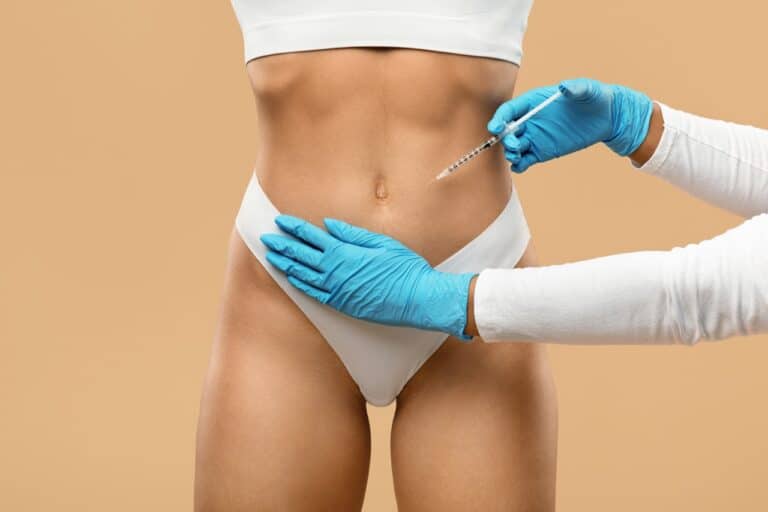
Abdominal lipolysis is a non-surgical body-contouring treatment that aims to reduce stubborn, localised fat on the abdomen and waist – fat that resists diet and exercise – with targeted injections instead of liposuction. Fat around the belly and the sides (“love handles”) is one of the most common concerns for both women and men, and it can affect everything from clothing choices to self-confidence. It is often linked to genetics, hormonal changes or ageing and may not respond even to a disciplined lifestyle.
The treatment uses lipolytic agents such as phosphatidylcholine and deoxycholic acid, which disrupt the membranes of fat cells and break them down permanently (adipocytolysis). They are injected with very fine needles directly into the subcutaneous fat of the abdomen. This irreversibly reduces the number of fat cells in the area, and the released fat is cleared by the body’s lymphatic system. The aim is not weight loss but a measurable local reduction in centimetres and a flatter, more attractive abdominal contour. At our clinic in Beşiktaş, Istanbul, each treatment is planned around the patient’s individual body structure.
What Is Abdominal Lipolysis and How Does It Work?
Abdominal lipolysis is an injection-based treatment for local slimming of the abdomen, love handles and waist. It is a body-shaping and contouring procedure, not a weight-loss method: its purpose is to smooth bulges and disproportions for a more attractive silhouette.
It is based on chemical adipocytolysis – permanently destroying fat cells by disrupting their membranes. The key molecules are phosphatidylcholine (PPC) and deoxycholic acid (DC). PPC, a phospholipid derived from soya and a natural component of cell membranes, has a limited fat-dissolving effect on its own but works synergistically with DC, a bile acid that acts like a detergent, destabilising the fat cell’s lipid membrane. As stored fat (triglycerides) leaks out, PPC emulsifies it into smaller, more fluid droplets, and the fat cell breaks down completely.
After injection, the body’s natural clearing mechanisms take over. The broken-down cells and fat droplets trigger a controlled inflammatory response; scavenger cells called macrophages engulf the debris, which is carried through the lymphatic system to the liver to be metabolised and eventually eliminated. This continues for weeks and months after each session, so results appear gradually. The process also stimulates fibroblasts to produce new collagen (neocollagenesis), helping the skin tighten somewhat and reducing the risk of laxity after treatment. I analyse each patient’s fat thickness, skin quality and body structure to create a personal injection plan and session schedule.
Who Can Benefit?
Abdominal lipolysis is not a magic wand for everyone with abdominal fullness, so correct patient selection is essential. The ideal candidate has a normal or near-normal body mass index (is not obese), has healthy habits such as a balanced diet and regular exercise, and still has stubborn, localised fat on the abdomen and waist that does not respond to these efforts.
The most important distinction is the type of fat. There are two types of abdominal fat: subcutaneous fat, just under the skin, soft and pinchable; and visceral fat, around the internal organs. Lipolysis can only target subcutaneous fat. Visceral fat is metabolically more harmful and cannot be treated with injection lipolysis; it can only be reduced through diet, exercise and overall weight loss. Assessing how much of the abdominal fat is subcutaneous is therefore critical.
Good to moderate skin elasticity is also important, so the skin can adapt to the new contour. In people with very poor elasticity, advanced sagging or separation of the abdominal muscles (diastasis recti), reducing fat may make sagging worse; for them, combining lipolysis with skin-tightening treatments such as radiofrequency or ultrasound, or surgery (abdominoplasty), may be more suitable.
It is not suitable during pregnancy or breastfeeding, for people with a soya allergy (for PPC products), serious systemic illness such as liver or kidney failure, bleeding disorders, or an active infection or open wound in the area. If you are not a suitable candidate, I will tell you honestly and suggest alternatives.
Step by Step: The Treatment Session
Consultation and Planning
I ask about your goals, the methods you have tried and your lifestyle, then examine your abdomen, using a “pinch test” to assess the thickness of subcutaneous fat, along with its distribution and density and your skin’s elasticity. If you are suitable, a personal treatment map is created: the abdomen is usually marked with a grid, with a planned amount for each small square (usually 1–2 cm²). For satisfying results, a course of 4 to 8 sessions, 2–4 weeks apart, is usually recommended. You are told realistically what to expect, especially swelling, bruising and tenderness in the first few days.
The Procedure
- Preparation: the whole abdomen and waist are disinfected and the treatment map is drawn on the skin with a sterile pen for symmetrical, even injections. A topical anaesthetic cream or a cold compress can be used to reduce needle sensitivity.
- Injections: the solution is injected with very fine, short mesotherapy needles into the subcutaneous fat at the correct depth, a small pre-calculated amount at each marked point, systematically covering the abdomen and, if needed, the love handles. This usually takes 15 to 30 minutes.
- Finishing: a gentle massage may help spread the solution, and the area is cleaned again. The whole session takes about 30–45 minutes.
Recovery and Results
You can return to daily life straight away, but some temporary reactions are normal and show that the fat cells are breaking down:
- Swelling: usually most noticeable in the first 2–3 days, decreasing over 1–2 weeks.
- Tenderness and discomfort: the area may be sensitive or mildly painful, with a burning sensation, usually controlled with simple painkillers and passing within a few days.
- Bruising and nodules: small bruises may appear, and small firm lumps may be felt under the skin where fat is breaking down; these usually disappear within a few weeks as the body clears them, and gentle massage can help.
Visible results appear in the weeks after sessions. A reduction in waist measurement and looser-fitting clothes are usually noticed after the 3rd or 4th session, and the final result becomes clear 1–2 months after the course: a flatter abdomen with better-defined contours. Results are long-lasting as long as a healthy lifestyle is maintained, and vary between individuals. Please note that the use of these solutions on the body may be off-label in some countries; I will discuss the products used with you.
Book Abdominal Lipolysis
We will assess together whether it suits you.
This page is for general information. Suitability, possible side effects and expected results are assessed at a medical consultation; results vary between individuals.